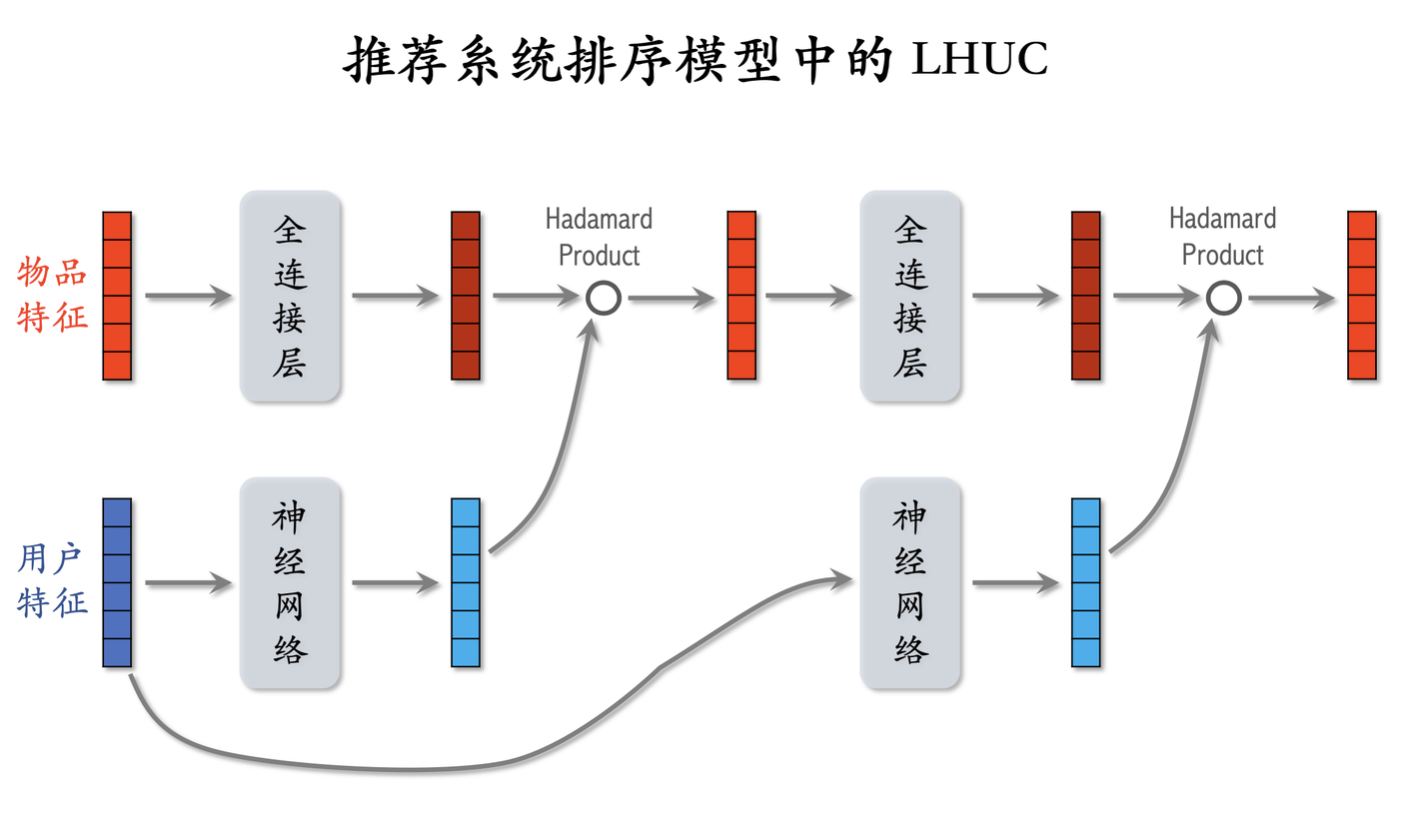
1
2
3
4
5
6
7
8
9
10
11
12
13
14
15
16
17
18
19
20
21
22
23
24
25
26
27
28
29
30
31
32
33
34
35
36
37
38
39
40
41
42
43
44
45
46
47
48
49
50
51
52
53
54
55
56
57
58
59
60
61
62
63
64
65
66
67
68
69
70
71
72
73
74
75
76
77
78
79
80
81
82
83
84
85
86
87
88
89
90
91
92
93
94
95
96
97
98
99
100
101
102
103
104
105
106
107
108
109
110
111
112
113
114
115
116
117
118
119
120
121
122
123
124
125
126
127
128
129
130
131
132
133
134
135
136
137
138
139
140
141
142
143
144
145
146
147
148
149
150
| import torch
import torch.nn as nn
class LHUCLayer(nn.Module):
"""
LHUC (Learning Hidden Unit Contributions) Layer
核心功能:根据用户个性化特征,学习对共享隐层单元的缩放权重。
"""
def __init__(self, hidden_dim, user_dim, scaling_func='2sigmoid'):
"""
:param hidden_dim: 共享隐层的维度(需要被缩放的维度)
:param user_dim: 用户个性化特征的维度(Gate的输入维度)
:param scaling_func: 缩放函数的类型,'2sigmoid' 是推荐系统中常用的(范围 0~2),
'exp' 或 'sigmoid' 也是可选方案。
"""
super(LHUCLayer, self).__init__()
self.scaling_func = scaling_func
self.gate = nn.Linear(user_dim, hidden_dim)
nn.init.zeros_(self.gate.bias)
nn.init.xavier_uniform_(self.gate.weight)
def forward(self, hidden_input, user_feature):
"""
:param hidden_input: (Batch, Hidden_Dim) 共享网络的隐层输出
:param user_feature: (Batch, User_Dim) 用户个性化特征 (如 User ID Embedding)
"""
gate_out = self.gate(user_feature)
if self.scaling_func == '2sigmoid':
scale = 2.0 * torch.sigmoid(gate_out)
elif self.scaling_func == 'sigmoid':
scale = torch.sigmoid(gate_out)
elif self.scaling_func == 'exp':
scale = torch.exp(gate_out)
else:
scale = gate_out
return hidden_input * scale
class SimplePPNet(nn.Module):
"""
一个集成 LHUC 的简单推荐模型 (类似 PPNet 结构)
结构:Embedding -> MLP (with LHUC) -> Output
"""
def __init__(self, feature_dim, user_num, user_emb_dim, hidden_units=[64, 32]):
super(SimplePPNet, self).__init__()
self.user_embedding = nn.Embedding(user_num, user_emb_dim)
self.fcs = nn.ModuleList()
self.lhuc_layers = nn.ModuleList()
input_dim = feature_dim
for unit in hidden_units:
self.fcs.append(nn.Linear(input_dim, unit))
self.lhuc_layers.append(LHUCLayer(unit, user_emb_dim))
input_dim = unit
self.activation = nn.ReLU()
self.final = nn.Linear(input_dim, 1)
self.sigmoid = nn.Sigmoid()
def forward(self, dense_features, user_ids):
user_emb = self.user_embedding(user_ids)
curr_out = dense_features
for fc, lhuc in zip(self.fcs, self.lhuc_layers):
curr_out = fc(curr_out)
curr_out = self.activation(curr_out)
curr_out = lhuc(curr_out, user_emb)
logits = self.final(curr_out)
return self.sigmoid(logits)
def test_lhuc_implementation():
print("=== 开始测试 LHUC 实现 ===")
BATCH_SIZE = 4
FEATURE_DIM = 10
USER_NUM = 100
USER_EMB_DIM = 8
HIDDEN_UNITS = [16, 8]
model = SimplePPNet(FEATURE_DIM, USER_NUM, USER_EMB_DIM, HIDDEN_UNITS)
print(f"模型结构:\n{model}")
dummy_features = torch.randn(BATCH_SIZE, FEATURE_DIM)
dummy_user_ids = torch.randint(0, USER_NUM, (BATCH_SIZE,))
print(f"\n输入数据形状: Feature {dummy_features.shape}, UserID {dummy_user_ids.shape}")
try:
output = model(dummy_features, dummy_user_ids)
print(f"前向传播输出形状: {output.shape}")
print(f"输出值示例: {output.detach().view(-1).numpy()}")
except Exception as e:
print(f"前向传播失败: {e}")
return
try:
loss = output.mean()
loss.backward()
print("反向传播成功,梯度正常计算。")
lhuc_grad = model.lhuc_layers[0].gate.weight.grad
if lhuc_grad is not None:
print(f"LHUC Gate 梯度范数: {lhuc_grad.norm().item():.4f}")
else:
print("警告: LHUC 层没有梯度!")
except Exception as e:
print(f"反向传播失败: {e}")
if __name__ == "__main__":
test_lhuc_implementation()
|